You fill in the years of experience. You write the paragraph about being a dedicated team player. You attach a resume for a job that pays by the hour.
Then you get the shift, or you do not, and you never find out which part of that mattered.
So what do employers look for in part time workers, if not the form? The uncomfortable part is that for most part-time and shift roles, a good deal of what the form asks for has very little to do with how the decision gets made. Some of it has very little to do with whether you would be good at the job either, and there is a large body of research saying so.
Key takeaways
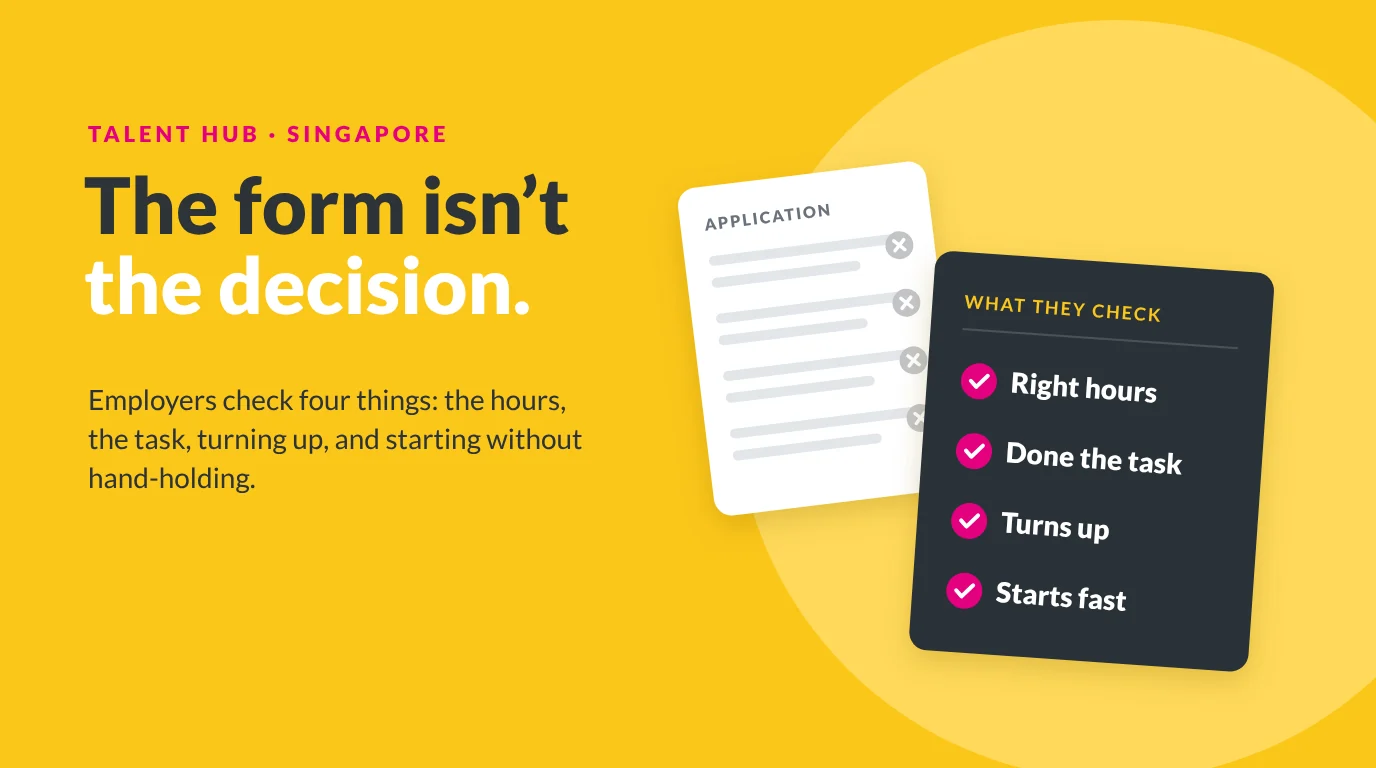
- What do employers look for in part time workers? Mainly four things: whether you can work the exact hours, whether you have done the task, whether you will turn up, and whether you can start without much supervision.
- Years of experience predicts job performance at only about 0.07, against 0.42 for structured interviews (Journal of Applied Psychology, 2022).
- In MOM’s 2025 Job Vacancy Survey, 46.2% of non-PMET vacancies and 54.7% of F&B vacancies in Singapore required no prior work experience.
- The highest-return thing on any part-time application is your availability, written as exact dates and times.
The form and the decision are two different things
A hiring form is a filing system. It exists so that a company can store applications in a standard shape, satisfy its own processes, and defend a decision later if asked.
The decision is something else. It usually happens in under a minute, in the head of an outlet manager who is also running a floor, and it turns on three or four practical questions that the form may not even ask directly.
So what do employers look for in part time workers, once the form is filed? Mostly the answers to those few questions. Understanding that gap is how you stop wasting effort on the parts nobody weighs.
What actually predicts whether someone is good at a job
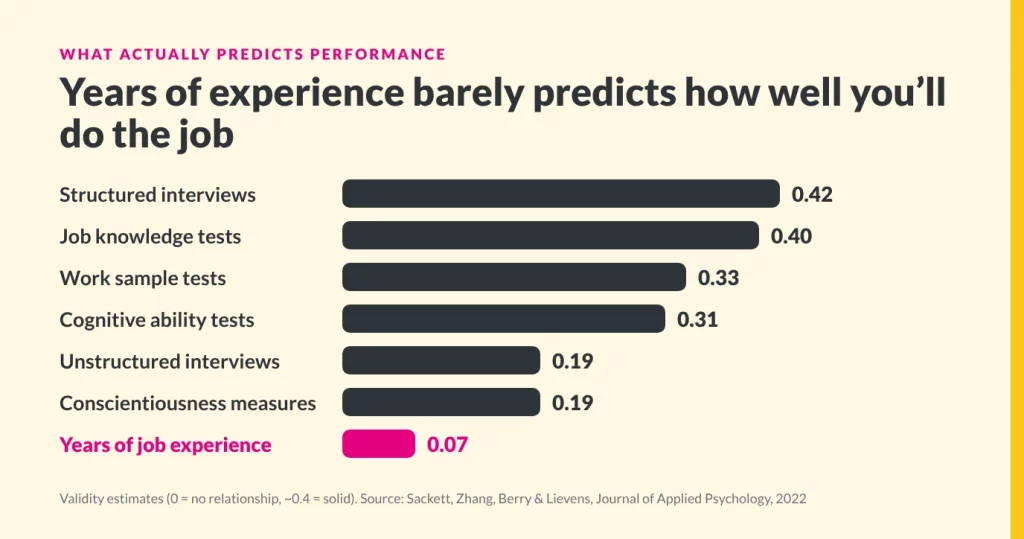
What do employers look for in part time workers when the method is chosen by evidence rather than habit? This has been measured, repeatedly, for decades. The most recent major re-analysis is by Sackett, Zhang, Berry and Lievens, published in the Journal of Applied Psychology in 2022, which corrected a statistical problem that had inflated earlier estimates.
They report how strongly each common hiring method predicts later job performance. The figures are validity estimates, adjusted for the fact that job performance itself is measured imperfectly, and they run on a scale where 0 means no relationship at all. Around 0.4 is a solid relationship by the standards of this field. Anything under about 0.1 is close to noise.
The results, roughly in order:
| Hiring method | Validity (2022 estimate) | What it means |
|---|---|---|
| Structured interviews | 0.42 | The same job-relevant questions, asked of everyone, scored consistently |
| Job knowledge tests | 0.40 | Do you actually know how to do the thing |
| Work sample tests | 0.33 | Doing a piece of the real job |
| Cognitive ability tests | 0.31 | General reasoning tests |
| Unstructured interviews | 0.19 | A conversation that wanders wherever it wanders |
| Conscientiousness measures | 0.19 | Personality questionnaires on diligence and reliability |
| Years of job experience | 0.07 | Close to no relationship with performance |
The last figure is the one worth dwelling on. Years of experience, the single most prominent field on almost every application form, predicts job performance at about 0.07. Close to nothing.
Years of education does not do much better. The authors could not produce a revised estimate for it at all, and the older figure was around 0.10.
One caution about reading that as a league table: the authors themselves warn against ranking predictors directly against each other, because the studies behind each figure cover different jobs and make different assumptions. The gap between 0.42 and 0.07 is wide enough to act on. The gap between 0.42 and 0.40 is not.
So the form leads with the two things that barely predict anything, and the methods that predict best either never appear in frontline hiring, or appear in a weakened form.
So why does the form still ask?
There are real reasons, and knowing them helps you work with the system rather than resent it.
Years of experience is cheap to collect and easy to sort. A structured interview takes a trained manager a serious chunk of time per candidate. A number in a box takes nobody any time at all.
It is also defensible. If a hiring decision is ever questioned, “we required two years of experience” sounds like a reason. “The manager had a good feeling” does not, even when the feeling was better evidence.
And most of these forms were inherited, built for salaried roles and copied downward into hourly hiring without anyone asking whether the fields still made sense for a four-hour shift. What do employers look for in part time workers, then, if the form is mostly habit? The four checks below.
What Singapore’s own hiring data shows
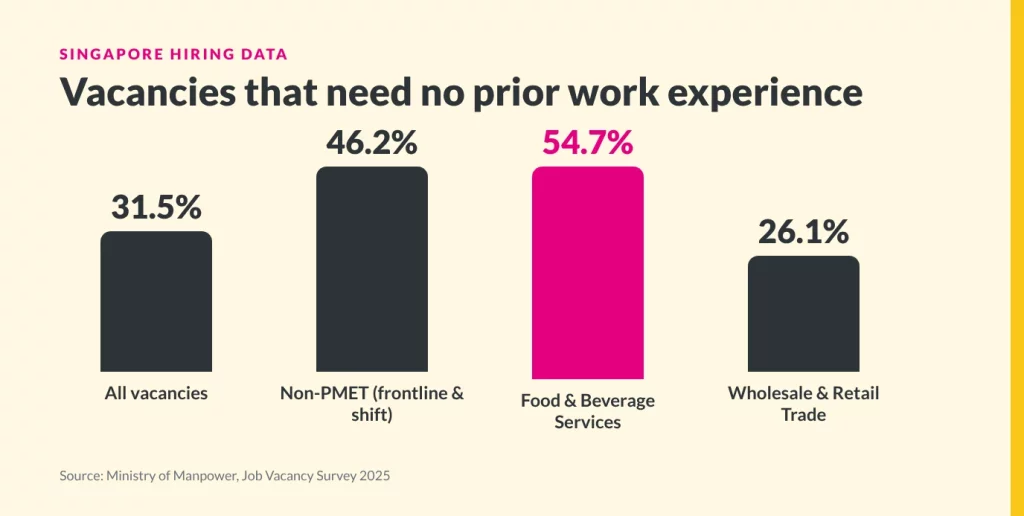
The validity research is international. Singapore has its own numbers, and they point the same way.
Every year the Ministry of Manpower runs a Job Vacancy Survey asking employers what they are hiring for and what they require. In the 2025 survey, 31.5% of all vacancies in Singapore required no prior work experience at all. Among non-PMET vacancies, the frontline and shift roles, the figure was 46.2%. In Food and Beverage Services it was 54.7% of vacancies in the sector.
| Vacancy group (Singapore, 2025) | Share requiring no prior work experience |
|---|---|
| All vacancies | 31.5% |
| Non-PMET (frontline and shift) vacancies | 46.2% |
| Food and Beverage Services | 54.7% |
| Wholesale and Retail Trade | 26.1% |
More than half the openings in food and beverage are not asking for experience. If you have been reading job listings and concluding that the door is shut because you have none, the national data says otherwise.
Wholesale and Retail Trade is tighter at 26.1%, so this varies by sector. It is still roughly one vacancy in four.
The survey also asks employers why their vacancies are hard to fill, and the contrast between the two halves of the labour market is the useful part. For professional and managerial roles, employers named candidate shortcomings first: 52.3% said candidates lack the necessary specialised skills and 48.2% said they lack the necessary work experience.
For non-PMET roles, the answers were about the job, not the candidate:
- 42.9% said candidates find the job physically strenuous
- 39.1% said the working hours are long
- 37.4% said the pay is unattractive
- 33.8% said candidates prefer not to do shift work, or work on weekends and public holidays
- 28.8% said the job lacks career prospects
Employers could give more than one answer, and the survey reports only the top five. Note what is missing: for frontline vacancies, a lack of experience does not appear among them at all, while for professional roles it is the second most cited reason. Whatever else is making shift roles hard to fill, the shortage employers name is of people willing to do those hours.
That changes where your advantage sits. Singapore had 68,600 job vacancies in June 2026, about 1.48 for every unemployed person. In a market like that, for roles where half the openings do not ask for experience and the binding constraint is who will work a Saturday evening, the most valuable thing you can state is not your history. It is your availability. What do employers look for in part time workers in a market like this? People who will actually take the hours.
What do employers look for in part time workers? The four real checks
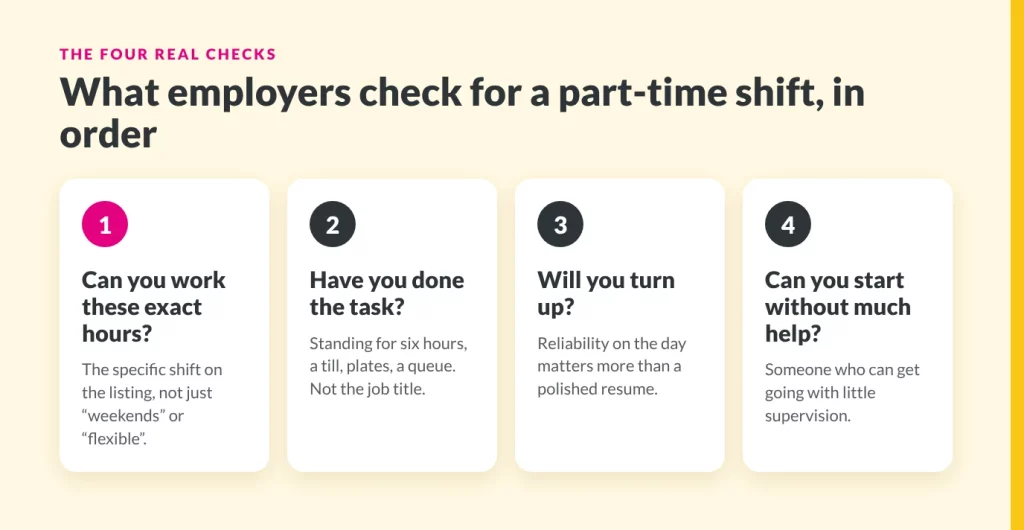
Underneath the form, someone hiring for a specific shift is answering four questions, in roughly this order.
Can you work these exact hours
The specific block on the listing, rather than “weekends” or “flexible”.
This is the question that gets asked first, and it is brutal. If a manager cannot tell within a couple of seconds that you are free for that exact shift, they move to the next application. In our experience it eliminates more applicants than anything else, and most of them never find out that the problem was availability rather than ability.
Have you done the task, not held the job title
They are not matching your job titles against theirs. They are asking whether you have stood for six hours, handled a till, carried plates, dealt with a queue of irritated people.
This is closer to a job knowledge check than a resume check, which is why it predicts better. It is also why someone with no formal retail history but plenty of relevant task experience can beat someone with two years at a competitor.
Will you turn up
The one they care most about and can see least directly. A no-show costs an employer far more than the wage they saved, so reliability is weighted heavily even when nobody says so.
Having no direct evidence, they read proxies: how quickly you replied, whether your profile is complete, whether you have a rating or a record of shifts actually worked.
Can you start without much hand-holding
During a busy period, a worker who needs forty minutes of supervision is a cost, not a help. Anything suggesting you can be shown once and left alone counts for a lot.
Part-time job application tips: what to put in front of them instead
Given all of the above, here is where your effort actually pays.
Availability, in dates and times
Write “Available Sat 15 Nov, 10am to 6pm, and every Saturday after” rather than “flexible weekends.”
This is the highest-return thing on the list, because it addresses the first filter directly and almost nobody does it properly.
A track record someone can check
Shifts worked, ratings, a manager who will confirm you turned up. Verifiable history beats an assertion about yourself, because the employer knows you wrote the assertion.
This is also why the first few shifts anywhere are worth more than they pay. They convert you from a claim into a record.
Certifications, because they travel better than experience
Food hygiene, a security licence, first aid. These are job knowledge in a form someone else has verified, and job knowledge is near the top of the predictive list at 0.40.
A certificate is also binary and checkable in a way that “two years of experience” never is. Say you have it and say when it expires.
An offer to do a trial shift
If you can, offer to work a short trial. That is a work sample, and at 0.33 it is one of the better predictors available. More importantly, it is the one thing that completely bypasses the form.
Most employers will not take you up on it. The ones who do have just given you the strongest card a frontline worker can play, which is the chance to be judged on the work.
What to stop spending time on
What do employers look for in part time workers? Not any of the following, so stop spending time on them.
Rewriting your resume for each application. For short shifts it is rarely the deciding document, and the time is better spent applying early to listings that genuinely fit.
The paragraph about your passion for customer service. Everyone writes it, nobody is differentiated by it, and it maps to the unstructured, low-predictive end of the evidence.
Padding years of experience. It is the weakest predictor on the form, and if you stretch it you are now relying on a claim you cannot support.
Applying to listings whose hours you cannot actually do, hoping for flexibility later. You will fail the first filter and spend the effort anyway.
One caveat worth being honest about
The research above is overwhelmingly US, and most of it measures people already doing the job rather than following applicants from hiring onward. The authors also note that the jobs studied differ from one predictor to the next, which is part of why they warn against direct comparison.
The broad pattern, that structured and job-relevant methods beat credentials and loose conversation, holds consistently enough to act on. Treat the exact numbers as the direction of the evidence rather than a precise law of frontline hiring.
And some employers genuinely do weight experience heavily, whatever the research says. You are working with their process, not the ideal one. The point is to know which parts of it carry weight so you can put your effort there. What do employers look for in part time workers? Treat this article as the default answer, then adjust for the employer in front of you.
How to get hired part time in Singapore without the guesswork
What do employers look for in part time workers on Flexii? The same four checks, with the hours, the rate and the payment all stated before you accept, so the first filter is something you can check yourself.
FAQ: what do employers look for in part time workers?
What do employers look for in part time workers?
What do employers look for in part time workers? Four things, roughly in order: whether you can work the exact hours advertised, whether you have done the actual task before, whether you will turn up, and whether you can work with minimal supervision. Job titles and years of experience matter far less than most application forms imply.
Does years of experience matter for a part-time job?
Less than almost anyone expects. A 2022 re-analysis published in the Journal of Applied Psychology found years of job experience predicts job performance at a correlation of about 0.07, which is close to no relationship. Structured, job-relevant questions predict at about 0.42.
Can I get a part-time job in Singapore with no experience?
Often, yes. In the Ministry of Manpower’s Job Vacancy Survey for 2025, 31.5% of all vacancies in Singapore required no prior work experience, rising to 46.2% of non-PMET vacancies and 54.7% of vacancies in Food and Beverage Services. Wholesale and Retail Trade was lower at 26.1%. For frontline roles, employers told the survey their hiring difficulty comes from the hours and the physical demands, not from a shortage of experienced candidates.
Do I need a resume for a part-time job in Singapore?
Often not, and where one is requested it is rarely the deciding document for a short shift. Stating your availability in specific dates and times, naming the tasks you have done, and listing any certifications usually does more work than a resume.
What is the best thing to put on a part-time job application?
Specific availability. Write the exact dates and times you can work rather than “flexible.” It directly answers the first thing a hirer checks, and most applicants leave it vague, so it is the cheapest way to stand out.
Should I offer to do a trial shift?
If you can, yes. A trial is a work sample, which predicts job performance better than an interview conversation, and it lets you be judged on the work rather than on the form. Most employers will decline, but the ones who accept have given you the strongest opportunity available.
References
- Sackett, P. R., Zhang, C., Berry, C. M. and Lievens, F. (2022), “Revisiting Meta-Analytic Estimates of Validity in Personnel Selection: Addressing Systematic Overcorrection for Restriction of Range”, Journal of Applied Psychology, 107(11), 2040–2068. An open copy of the paper is available here. Source of the revised validity estimates for structured interviews, job knowledge tests, work samples, unstructured interviews and years of job experience.
- Ministry of Manpower, Job Vacancies 2025, Manpower Research and Statistics Department: the share of vacancies requiring no prior work experience overall, for non-PMET roles and for Food and Beverage Services and Wholesale and Retail Trade, and the reasons employers gave for hard-to-fill PMET and non-PMET vacancies. Survey reference date 30 September 2025; employers could give more than one reason.
- Ministry of Manpower, Labour Market Report Second Quarter 2026: 68,600 job vacancies in June 2026 and 1.48 vacancies per unemployed person.
- Ministry of Manpower, Part-time employment: the definition of part-time work and the entitlements that apply.
- Ministry of Manpower, Progressive Wage Model for the retail sector: the hourly wage floors for covered retail roles.
Singapore figures: MOM Job Vacancy Survey (reference date 30 September 2025) and Labour Market Report, second quarter 2026. The validity research is mostly US and is cited as the direction of the evidence, not a precise account of shift hiring in Singapore.