

Payday came and went. You checked the account twice. The manager says it is being processed, or says nothing at all.
If you are dealing with an employer not paying salary in Singapore, the useful thing to know first is that the law here is specific about dates. Your salary is not due “around the end of the month” or “when the boss gets to it.” It has a deadline, missing it is a criminal offence, and there is a process that costs you ten dollars.
Here are the five steps to take with an employer not paying salary, in order, with what each one actually takes.
Late payment is an offence, not a favour you are asking for
Start here, because it changes the tone you take with an employer not paying salary.
An employer not paying salary on time is committing an offence under the Employment Act 1968. Under section 34(2), a first conviction carries a fine of not less than $3,000 and up to $15,000, or imprisonment of up to 6 months, or both. For a repeat offender it is a fine of not less than $6,000 and up to $30,000, or up to 12 months’ imprisonment, or both.
Note the minimum. The court cannot hand an employer not paying salary a token fine.
You are not asking for a favour or being difficult. You are pointing out that a legal deadline has passed. Being polite still works faster, but you should know where you stand while you are being polite.
Step 1: Count the days and confirm it is actually late
The Employment Act sets the deadlines. Your employer must pay you at least once a month, and payment is due within 7 days after the end of the salary period.
Overtime runs on a separate clock: it is due within 14 days after the end of the salary period.
If you have left the job, the deadline depends on how you left:
- You resigned and served your notice: your final salary is due on your last day of work.
- You resigned without serving notice: within 7 days of your last day.
- Your employer terminated you, or dismissed you for misconduct: on the last day, or if that is not possible, within 3 working days.
Count the days before you treat it as a case of an employer not paying salary. Plenty of workers assume they are owed money on the day salary “normally” arrives, when the legal deadline is a few days later. Just as many keep waiting when the deadline passed a week ago.
Step 2: Ask in writing, today
Once you have confirmed the deadline has passed, send one written message. WhatsApp is fine. Email is better.
Keep it short and factual: the salary period, the amount, the date it was due, and a request for a payment date. Something like: “Hi, my salary for 1 to 30 September has not come in. It was due on 7 October. Could you let me know when it will be paid?”
Two reasons this matters. Most cases of an employer not paying salary on time are administrative mess rather than bad faith, and a message often resolves it within a day. And if it does not resolve, you now have a dated record showing you raised it and what the response was. That record does real work later.
Do not let this stage drag. If you get no clear payment date within a few days, move on.
Step 3: Gather your evidence
While you wait for a reply, spend twenty minutes collecting these. If you end up filing a claim against an employer not paying salary, having them ready turns a painful afternoon into a short one.
- Your payslips, or the absence of them. Employers covered by the Employment Act must issue itemised payslips, so if you never received any, that is a separate breach worth mentioning.
- Your contract or Key Employment Terms, which state your salary rate and salary period.
- Your own record of shifts worked: dates, start and end times. If you have nothing, reconstruct it from your phone, rosters, group chats or photos.
- The written message you sent asking about payment, and any reply.
- Bank statements showing what did arrive and when.
The single most useful thing is your record of hours worked. An employer not paying salary on time is frequently the same employer whose records are unreliable, and yours may be the better evidence.
Step 4: File a claim with TADM for $10
If there is no clear payment date within a few days, stop waiting and file. The Tripartite Alliance for Dispute Management, TADM, handles claims against an employer not paying salary, and this is the step most people do not realise is available to them.
Who can file. All employees except seafarers, domestic workers, statutory board employees and civil servants. If you are a union member, contact NTUC instead and they will handle it.
The deadlines, which are strict.
- Still employed: file within 1 year of the dispute arising.
- Already left: file within 6 months of your last day of employment.
What it costs. A non-refundable filing fee of $10 for claims of $10,000 or below, or $20 above that. You pay within 3 days of filing or the claim is cancelled.
What it covers. Salary, overtime pay, bonuses, commissions, unauthorised deductions and maternity benefits.
How long it takes. Filing itself takes about 20 minutes online. Within 3 working days of paying the fee, you will get an email telling you the next step.
Mediation follows. Both sides are brought together and most claims end here, because an employer not paying salary, once facing a formal claim and a possible prosecution, usually finds the money.
Step 5: Escalate to the Employment Claims Tribunal
If mediation does not resolve it, TADM issues you a claim referral certificate, and only then can you file at the Employment Claims Tribunal. Mediation is compulsory first; you cannot skip to the tribunal.
The limits are $20,000 per claim, or $30,000 if the claim is filed with union assistance or through the Tripartite Mediation Framework.
One detail people like: lawyers are not allowed to represent either side at the tribunal. You will not be outgunned by an employer who can afford counsel.
The tribunal tries settlement first, through online negotiation and a case management conference with the registrar. Only if that fails does it go to a hearing before a tribunal magistrate.
Two things that catch people out
The six-month deadline after you leave
The window closes at six months from your last day, not a year. People who quit a bad job, try to forget it, and remember the unpaid money eight months later find the door shut.
If you have left a job that still owes you money, check the date now.
Whether you count as an employee at all
This is the one that matters most for flexible and gig work.
The TADM and tribunal route is for employees. Self-employed people cannot use it. If you were engaged as a freelancer or an independent contractor rather than hired as an employee, your recourse is a contractual one rather than this process, which is slower and harder.
So it is worth knowing which you were. Signs you were an employee: the business set your hours, told you how to do the work, provided the equipment or uniform, and paid you a wage with CPF contributions rather than a fee against an invoice. The label on the arrangement matters less than how it actually worked in practice.
If you are unsure, TADM can advise you. Ask rather than assume you are excluded.
Employer not paying salary? You can stop working and keep the claim
This sits alongside the five steps rather than inside them, and it surprises people.
MOM’s position is that if you are still not paid your full salary within 7 days of it being due, your employer is considered to have breached the terms of employment. At that point you can terminate your employment without serving notice, and you should tell your employer your decision in writing.
That is a significant right, and it is worth understanding rather than using on impulse. Leaving does not recover the money you are already owed; you still need the claim process for that. But it means you are not trapped working unpaid shifts while you wait, and you will not owe notice pay for leaving.
Even with an employer not paying salary, MOM still recommends trying to resolve it with them first.
The version where none of this is necessary
Everything above exists because there is a gap between doing the work and receiving the money, and because an employer not paying salary on time can use that gap.
The gap is not a law of nature. It is a choice about how payment is set up. Shift work does not need a monthly cycle, a payroll run and a seven-day grace period, because the amount owed is known the moment the shift ends: hours worked, times the rate, both agreed before you started.
That is how payment works on Flexii. The shift ends, you withdraw, and the money arrives by PayNow the same day. No salary period, no seven-day wait, nothing to chase.
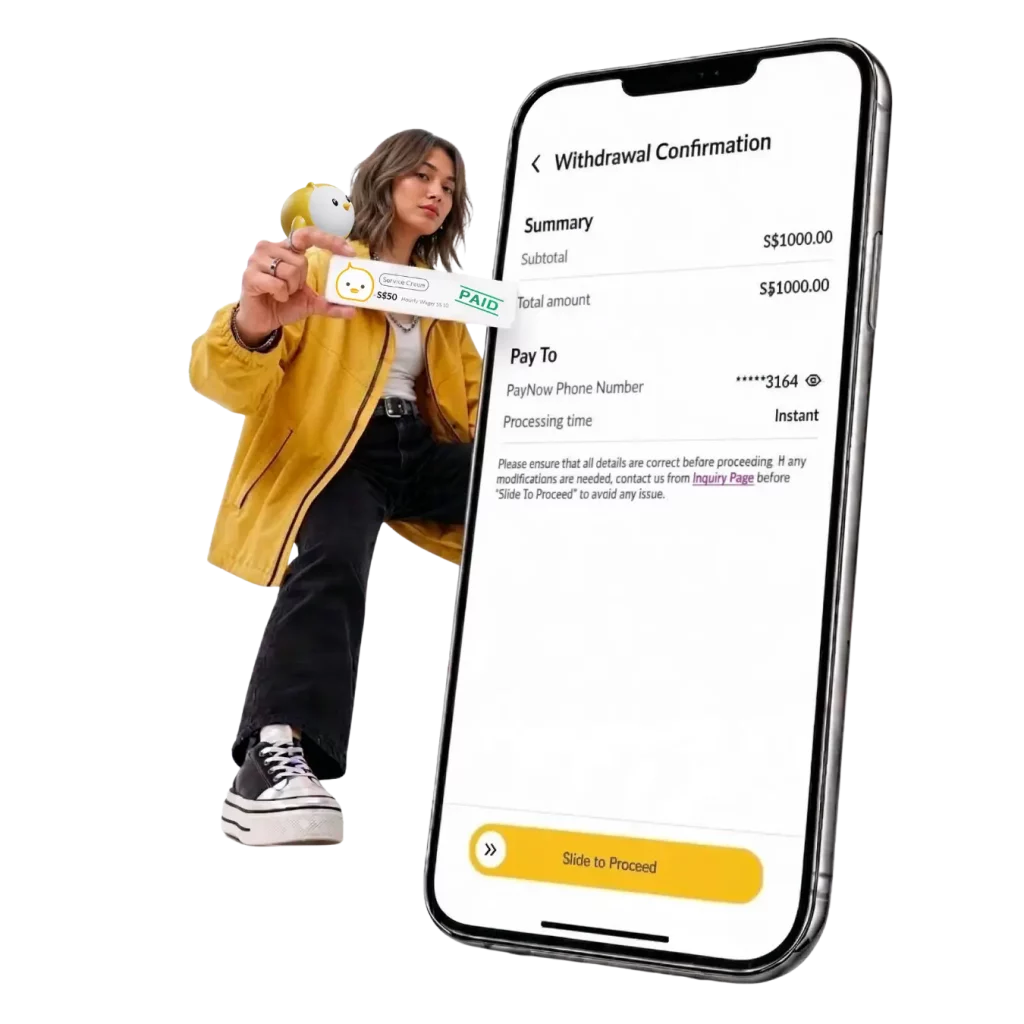
If you have spent this article counting days and hunting for payslips, that is the alternative worth knowing about. See part-time shifts with instant payouts.
And whatever you decide about future work, if you are dealing with an employer not paying salary right now, check your dates today. The six-month window is shorter than people expect.
This guide summarises publicly available MOM, TADM and Singapore Judiciary guidance as of September 2026. It is general information, not legal advice, and your situation may differ. Fees, limits and deadlines change, so check the linked sources before you file.