
Real operational transformation doesn’t start in corporate boardrooms with abstract labor models. It happens on the store floor—at 2:00 PM on a Saturday when a surge of foot traffic hits, or during pre-opening prep when a key staff member calls in sick.
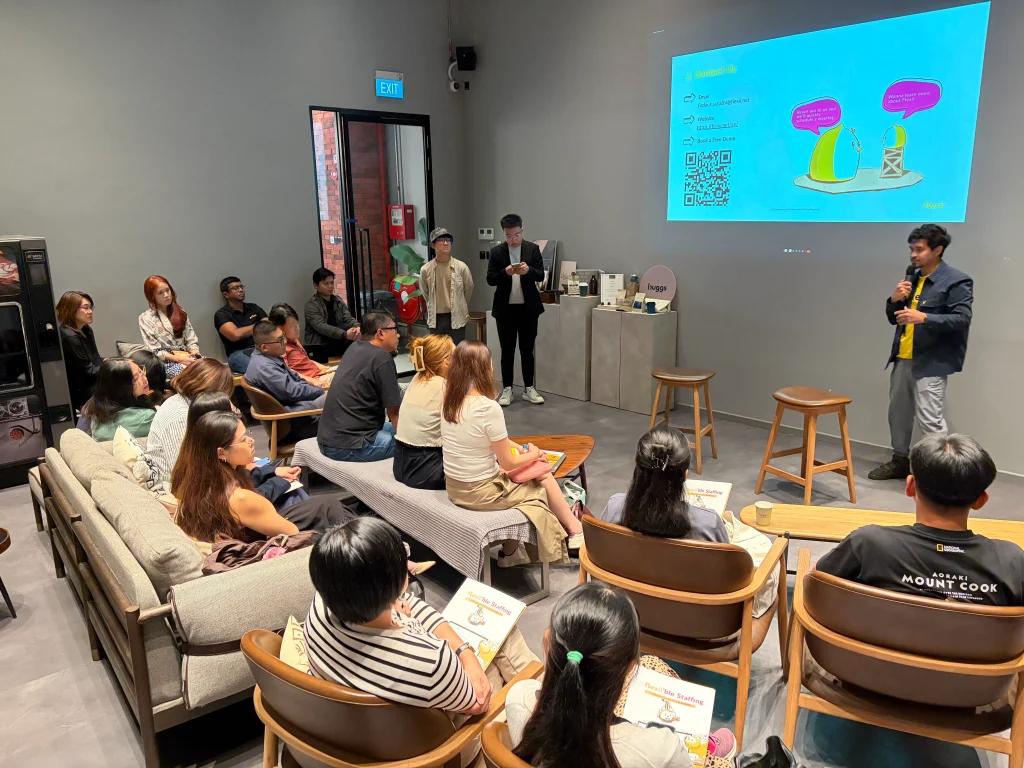
At our recent joint masterclass hosted alongside the Singapore Retailers Association (SRA) at Huggs Coffee Headquarters, we looked past high-level theories to focus squarely on ground truth: what actual store floor data from Singapore’s retail ecosystem tells us about solving workforce friction.
Here is the storytelling behind the numbers, and how forward-thinking retail leaders are reshaping their operations to build a faster, more resilient workforce.
1. The Death of the 8-Hour Block: Why Shorter Shifts Win
For decades, the standard 8-hour shift was treated as an unshakeable operational default. But when you look at actual frontline worker behavior, rigid full-day blocks are one of the primary drivers of low shift fulfillment.
The Field Reality:
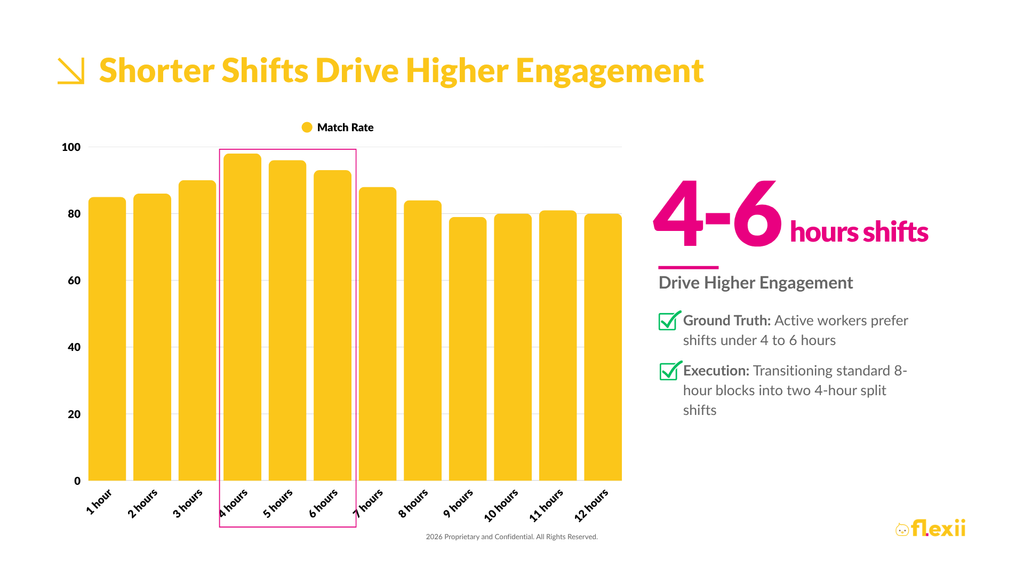
Frontline retail workers overwhelmingly prefer shorter, higher-intensity shifts. On the Flexii platform, over 90% of active workers prioritize shifts lasting between 4 to 6 hours.
The Operational Pivot:
When retailers break traditional 8-hour blocks into two 4-hour split shifts, the impact on fulfillment speed is immediate:
- Expanded Candidate Pool: Shorter windows fit seamlessly into the lives of students, caregivers, and part-timers who cannot commit to a full 8-hour day.
- Higher Floor Energy: Workers on 4-hour shifts maintain peak performance and enthusiasm throughout their entire time on the floor.
- Faster Matching: Shifts structured around worker preferences fill in minutes rather than days.
2. The “4-Shift Gateway”: Unlocking True Worker Retention
One of the greatest expenses on the retail floor is continuous retraining. High turnover among contingent staff creates constant friction for store managers who have to onboard new faces every week.
Through our store-level analytics, we identified a critical behavioral threshold: The 4-Shift Gateway.
The Field Reality:
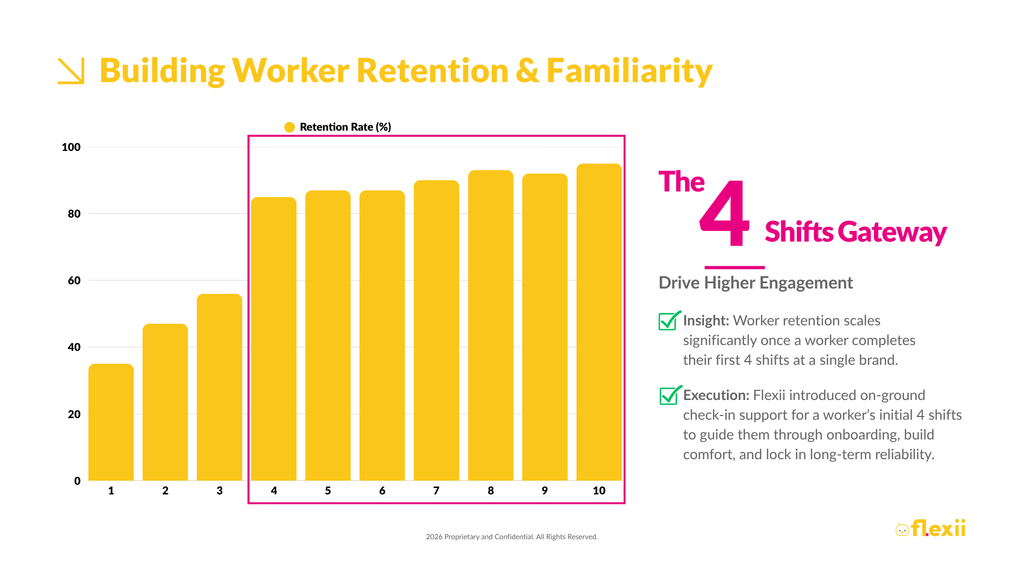
Worker retention isn’t linear. If a worker completes just 1 or 2 shifts at a store, they treat it as a one-off gig. However, once a worker completes 4 shifts at the same business, their likelihood of returning to that specific brand repeatedly scales dramatically.
The Operational Pivot:
Retention is an onboarding problem, not an incentive problem. By providing structured, hands-on support during a worker’s initial 4 shifts, retailers turn casual gig workers into familiar, reliable extended team members. Once past that 4-shift mark, workers know the layout, understand the brand expectations, and need minimal supervision—drastically reducing store manager burnout.
3. Instant Liquidity: Speed to Pay Equals Speed to Supply
Why do some shifts stay open for days while others fill in under 5 minutes? The answer lies in payout dynamics.
The Field Reality:
For front-line talent, immediate feedback loops matter. When analyzing post-shift wallet activity across our network:
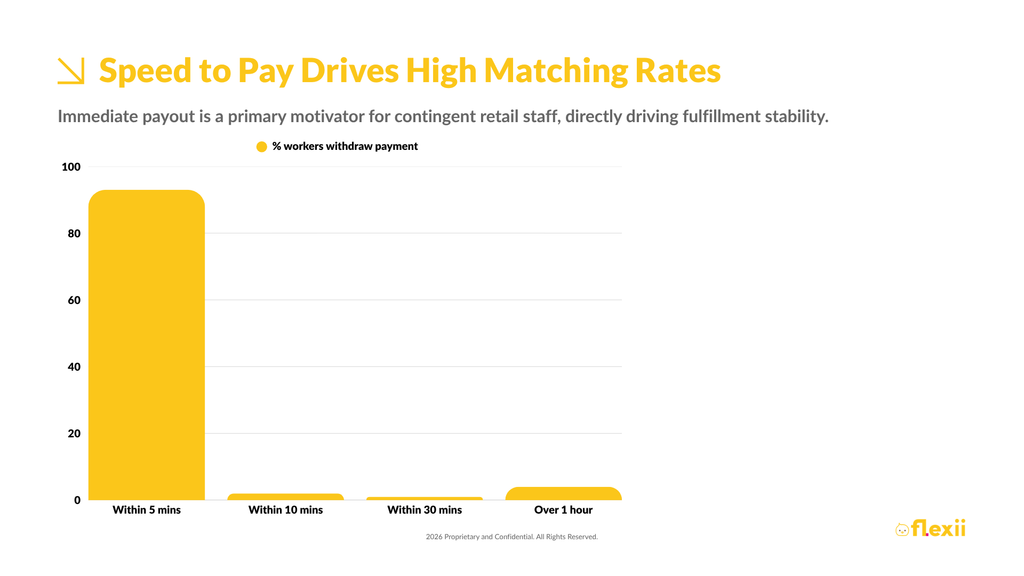
- 93% of workers withdraw their earnings within 5 minutes of completing a shift.
- 2% withdraw within 10 minutes.
- 1% withdraw within 30 minutes.
- Only 4% wait longer than an hour.
The Operational Pivot:
Instant payout liquidity is directly linked to store-level supply. Aligning post-shift payout speed with worker expectations drives a 97.2% overall shift matching rate across active retail stores in Singapore. When workers know their effort is rewarded instantly, platform engagement and shift uptake skyrocket.
4. Pool Stability: Turning Strategic Curations into Store Consistency
A common concern with flexible staffing is quality control—the fear that on-demand labor means sacrificing brand standards. The data tells a very different story when stores actively manage their talent pools.
The Field Reality:
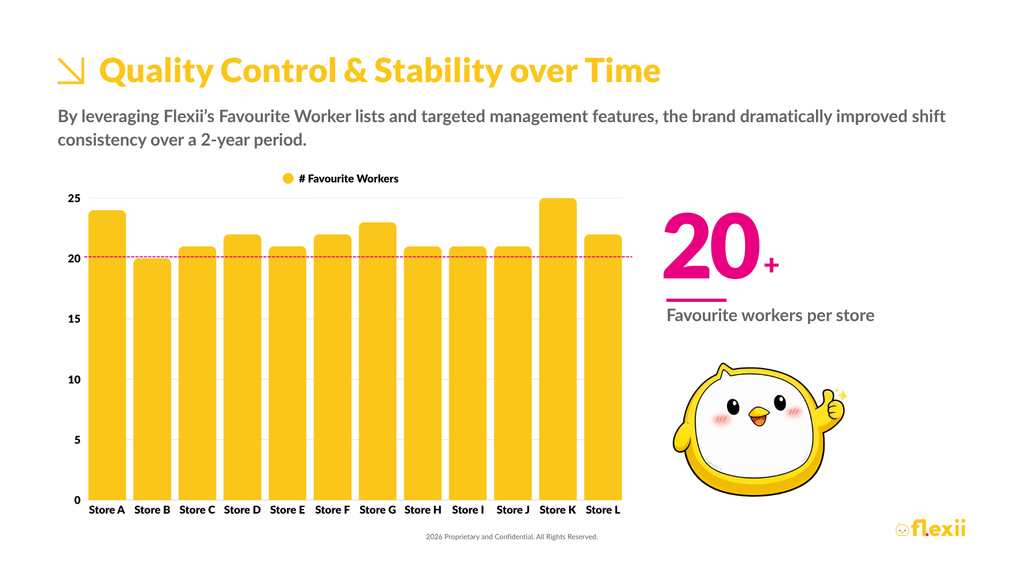
Retailers who actively build and rely on “Favorite Worker” pools see an immediate drop in store-level operational disruption. Over a 2-year tracking period across multi-store retail environments:
- Stores that built a core favorite pool of ~20 trusted workers saw their monthly worker block rates decline from an average of 8 workers/month down to ~1 worker/month.
The Operational Pivot:
Quality isn’t built through strict gatekeeping; it’s built through active curation. Giving store managers the tools to tag, re-book, and prioritize top performers transforms an open labor marketplace into a predictable, high-performing extension of their permanent team.
The Bottom Line
Solving retail workforce challenges requires a shift from fixed schedules to flexible, data-driven execution. By structuring shifts around worker preferences, guiding staff through early shift milestones, ensuring instant compensation, and curating trusted pools, retail managers can eliminate floor shortages and build long-term operational stability.
Ready to optimize your store floor with real-time workforce data?
👉 [Book a Demo with the Flexii Team Today to Explore Our Platform]
Real operational transformation doesn’t start in corporate boardrooms with abstract labor models. It happens on the store floor—at 2:00 PM on a Saturday when a surge of foot traffic hits, or during pre-opening prep when a key staff member calls in sick.
At our recent joint masterclass hosted alongside the Singapore Retailers Association (SRA) at Huggs Coffee Headquarters, we looked past high-level theories to focus squarely on ground truth: what actual store floor data from Singapore’s retail ecosystem tells us about solving workforce friction.
Here is the storytelling behind the numbers, and how forward-thinking retail leaders are reshaping their operations to build a faster, more resilient workforce.
1. The Death of the 8-Hour Block: Why Shorter Shifts Win
For decades, the standard 8-hour shift was treated as an unshakeable operational default. But when you look at actual frontline worker behavior, rigid full-day blocks are one of the primary drivers of low shift fulfillment.
The Field Reality:
Frontline retail workers overwhelmingly prefer shorter, higher-intensity shifts. On the Flexii platform, over 90% of active workers prioritize shifts lasting between 4 to 6 hours.
The Operational Pivot:
When retailers break traditional 8-hour blocks into two 4-hour split shifts, the impact on fulfillment speed is immediate:
- Expanded Candidate Pool: Shorter windows fit seamlessly into the lives of students, caregivers, and part-timers who cannot commit to a full 8-hour day.
- Higher Floor Energy: Workers on 4-hour shifts maintain peak performance and enthusiasm throughout their entire time on the floor.
- Faster Matching: Shifts structured around worker preferences fill in minutes rather than days.
2. The “4-Shift Gateway”: Unlocking True Worker Retention
One of the greatest expenses on the retail floor is continuous retraining. High turnover among contingent staff creates constant friction for store managers who have to onboard new faces every week.
Through our store-level analytics, we identified a critical behavioral threshold: The 4-Shift Gateway.
The Field Reality:
Worker retention isn’t linear. If a worker completes just 1 or 2 shifts at a store, they treat it as a one-off gig. However, once a worker completes 4 shifts at the same business, their likelihood of returning to that specific brand repeatedly scales dramatically.
The Operational Pivot:
Retention is an onboarding problem, not an incentive problem. By providing structured, hands-on support during a worker’s initial 4 shifts, retailers turn casual gig workers into familiar, reliable extended team members. Once past that 4-shift mark, workers know the layout, understand the brand expectations, and need minimal supervision—drastically reducing store manager burnout.
3. Instant Liquidity: Speed to Pay Equals Speed to Supply
Why do some shifts stay open for days while others fill in under 5 minutes? The answer lies in payout dynamics.
The Field Reality:
For front-line talent, immediate feedback loops matter. When analyzing post-shift wallet activity across our network:
- 93% of workers withdraw their earnings within 5 minutes of completing a shift.
- 2% withdraw within 10 minutes.
- 1% withdraw within 30 minutes.
- Only 4% wait longer than an hour.
The Operational Pivot:
Instant payout liquidity is directly linked to store-level supply. Aligning post-shift payout speed with worker expectations drives a 97.2% overall shift matching rate across active retail stores in Singapore. When workers know their effort is rewarded instantly, platform engagement and shift uptake skyrocket.
4. Pool Stability: Turning Strategic Curations into Store Consistency
A common concern with flexible staffing is quality control—the fear that on-demand labor means sacrificing brand standards. The data tells a very different story when stores actively manage their talent pools.
The Field Reality:
Retailers who actively build and rely on “Favorite Worker” pools see an immediate drop in store-level operational disruption. Over a 2-year tracking period across multi-store retail environments:
- Stores that built a core favorite pool of ~20 trusted workers saw their monthly worker block rates decline from an average of 8 workers/month down to ~1 worker/month.
The Operational Pivot:
Quality isn’t built through strict gatekeeping; it’s built through active curation. Giving store managers the tools to tag, re-book, and prioritize top performers transforms an open labor marketplace into a predictable, high-performing extension of their permanent team.
The Bottom Line
Solving retail workforce challenges requires a shift from fixed schedules to flexible, data-driven execution. By structuring shifts around worker preferences, guiding staff through early shift milestones, ensuring instant compensation, and curating trusted pools, retail managers can eliminate floor shortages and build long-term operational stability.
Ready to optimize your store floor with real-time workforce data?
👉 [Book a Demo with the Flexii Team Today to Explore Our Platform]